Article by Professor A. Tsakanikas on: Two out of three NTUA graduates turn to entrepreneurship
 Angelos Tsakanikas, Professor of Economic Evaluation of Innovation Technology and Entrepreneurship Systems at NTUA and Director of the Industrial and Energy Economics Laboratory (LIEE), published in the Greek economic and business news site Business Daily the article entitled “Two out of three NTUA graduates turn to entrepreneurship”. Entrepreneurship remains a strong option for NTUA graduates, with 66.6% seeing it as an opportunity. Challenges include small size and limited funding.
See the article here
Angelos Tsakanikas, Professor of Economic Evaluation of Innovation Technology and Entrepreneurship Systems at NTUA and Director of the Laboratory of Industrial and Energy Economics (LIEE), published in the Greek online platform B2Green the article entitled ‘’Need to improve the working environment for engineers for a substantial recovery of the country’’.
See the article here
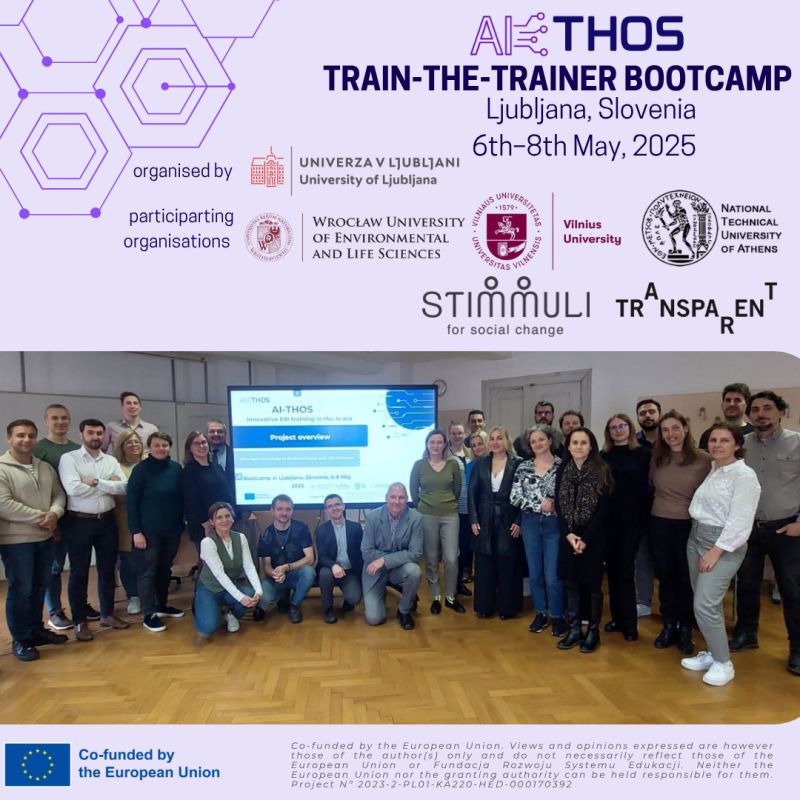
The Laboratory of Industrial & Energy Economics (LIEE-NTUA) proudly participated in the AI-THOS Train-the-Trainer International Bootcamp, held in Ljubljana, Slovenia (6–8 May 2025)—a milestone event advancing ethical, innovative AI integration in higher education.
AI-THOS project aims to train, support and empower teachers of higher education to integrate AI tools in the teaching process in alignment with Ethics & Research Integrity (ERI) principles.
The Bootcamp brought together academic partners from NTUA (Greece), Wroclaw University of Environmental and Life Sciences (Poland), Vilnius University (Lithuania), University of Ljubljana (Slovenia), and other societal partners (Stimmuli for Social Change and Art Transparent) in order to test and fine-tune the AI-THOS Train-the-Trainer programme for HEIs teaching staff—designed to support university educators in using AI tools aligned with ERI principles.
During the bootcamp, Aimilia Protogerou (Assistant Professor, LIEE-NTUA) and Panagiotis Panagiotopoulos (Post-doc Researcher, LIEE-NTUA) led a workshop exploring AI-powered teaching methods such as: Problem-Based Learning, Case-Based Learning, Flipped Classroom, Team-Based Learning, Jigsaw Method, Game-Based Learning.
They shared real-world examples based on interviews with university teachers already experimenting with AI tools—discussing both the pedagogical value and ethical challenges.
The workshop sparked a rich, interdisciplinary discussion on responsible AI usage in education—showcasing the importance of collaboration, experimentation, and ethics.
From the side of NTUA, four additional teachers-researchers participated and actively contributed to the Bootcamp’s activities: Giorgos Paraskevopoulos, Associate Researcher on machine learning at the Institute for Speech and Language Processing at “Athena” Research Center, Anna Bougia, Reseacher at the Computer Technology Institute & Press “Diofantus”, Petros Dimas, Post-doc Researcher, LIEE-NTUA, and Theodora Xenidou, Senior Researcher at NTUA.
Next step: The training materials will now be piloted across partner countries through national workshops—bringing AI & ethics to classrooms across Europe.


Announcement of Participation in the Coca Cola Summership Greece & Cyprus 2025 Youth Program
The Youth Program, Summership, of Coca Cola is an experience for students from Greece and Cyprus who are in their 3rd and 4th year of their studies to apply for a place in the 2-week hybrid program.
Through specially designed round tables & business cases with selected executives of the company, workshops, projects with the most emblematic brands of the market and tours of the company’s facilities, students will have the opportunity to get to know the organization.
The aim of this educational program is to benefit young people through a unique experience that will help them develop skills useful for their future professional development.
Upon completion of the programme cycle, a number of selected students will have the opportunity to apply for an internship in various departments of the organisation.
Those interested can apply until Friday 23/5.
For more information and to register: Summership Greece & Cyprus 2025

 Abstract:
The present book, a collaborative effort between academics and engineers with many years of professional experience, addresses the approach and practice of Project Management. It focuses on a fundamental professional activity for engineers and other scientists as more and more organizations and enterprises operate based on projects that support their typical organizational structures. The starting point and focus of the book is the management of engineering projects in industry, covering the definitions, principles, concepts, and phases of project management, as well as the analysis of individual stages and operations. Specifically, it discusses project planning, scheduling techniques, the organization and management of necessary engineering studies, technology selection, procurement, and various procurement contract forms, the organization of construction, testing, and commissioning of a new production unit, monitoring and controlling the implementation process and taking corrective actions, risk management, coordination and communication processes, and human resources management. The book also includes a series of case studies based on the authors’ experience, characterized by diversity in relevant fields (natural gas plant, municipal wastewater treatment plant, company relocation project, IT project). These case studies aim to provide a deep understanding of the horizontal application of basic project management principles while highlighting the relative differences between different project types in methodology, critical factors, and stages. Each chapter begins with a description of its learning objectives and ends with comprehension questions.
Authors:
Caloghirou, Yannis
Diakoulaki, Danae
Protogerou, Aimilia
Franses, Symeon
Gekas, Achilleas
Kalantzis, Polyvios
Panagiotopoulos, Panagiotis
Creation Date: 19-03-2025
Publication Origin: Kallipos, Open Academic Editions
68Number of pages: 368
Language: Greek
Κωδικός ISBN: 978-618-228-310-3