Recent International Projects
The aim of the project is to carry out targeted studies around the digital agenda of the EU institutions, with a particular focus on SMEs and the skills of citizens and workers. The areas of artificial intelligence, internet of things, big data, industry 4.0 and the impact on current and future employment are already affecting business and economic activities across Europe. These challenges require coordination of national and international policies. The thematic studies aim to create a platform for the exchange of ideas and actions that will highlight the main driving forces and obstacles that need to be addressed.
PromethEUs is an independent research network consisting of four think tanks from Southern European countries, active both in their own countries and at European Union level, specializing in the fields of economic, business, and geopolitical research. Specifically, it consists of the following think tanks: I–Com –Inst
The mission of the PromethEUs network is to contribute constructively to the current European policy debate on the digital revolution, offering a perspective from Southern Europe. PromethEUs aims to participate in the debate on the digital agenda of the EU institutions, with a particular focus on SMEs and the skills of citizens and workers. The fields of AI, IoT, the use of Big Data, elements of Industry 4.0, and their impact on current and future employment are already affecting business and economic activities across Europe.
The main goal of the TwInn4MicroUp project is to significantly and measurably increase the competitiveness and the capabilities of NTUA in the fields of Project Management & Administration, Budget Acquisition, and Synthetic Microbial Biotechnology for the elevation of NTUA’s research profile. This will be achieved by transferring research knowledge, excellence and best practices, from the three high-performance research establishments: Technological University of the Shannon: Midlands & Midwest (TUS), Athlone, Ireland; Belgrade, Serbia; The Microbial Biotechnology Laboratory of the Department of Bioscience, Biotechnology and Environment (UNIBA), Bari, Italy.
TwInn4MicroUp will generate 4 new state-of-the-art clean technology innovations that will lead to sustainable jobs, encompassing essential skills for the transition towards a greener future. Leveraging previous research achievements to valorise by-products of plastic waste and demonstrating the scale-up of these processes will highlight the untapped potential within low-value co-products and underscore the importance of pilot-scale research alongside laboratory developments. TwInn4MicroUp aims to educate and train researchers in Synthetic Microbial Biotechnology while fostering innovation through the formation of an expert network including the stimulation of relevant policy discussions. Our strategy involves engaging with the industry (over 100 companies), facilitating their active participation and investment, and working together to create a roadmap towards a greener, more innovative, and sustainable future. Through these collaborative efforts, NTUA aims to compete successfully at the EU level carrying out project coordination roles in HE initiatives.
LIEE-NTUA will support the creation of a Hub in the field of synthetic microbial biotechnology and will support the process of potential exploitation in the market of research ideas and results in order to link the rich production of innovative products in NTUA with existing or new firms in the specific sector.
The AI-THOS project aims to facilitate systematic and extensive training on Ethics and Research Integrity with a particular emphasis on the use of Artificial Intelligence technologies. The goal is to promote the principles of Ethics and Research Integrity, engage participants and their social networks in dialogue about the importance of these principles in scientific practices, and ultimately cultivate a culture of Ethics and Research Integrity in Europe. This culture will mitigate ethical implications and enhance trust in science and technology.
To achieve this goal, the project’s specific objectives are:
- Investigate successful educational practices and innovative teaching techniques by mapping existing educational practices on Ethics and Research Integrity.
- Strengthen the confidence and capacity of educators/trainers in Higher Education Institutions to provide training on these topics.
- Support the development of related competencies among students by implementing a pilot program in the participating Higher Education Institutions.
The aim of the project is the design, creation and operation of an integrated network of structures to highlight and support Entrepreneurship and Innovation in the Region of Peloponnese.
Specifically, LIEE will undertake the implementation of three (3) studies: a) “Entrepreneurship governance model study”, b) “Study of Research Utilization Practices (VALORISATION – SPIN OFFS)” and c) “Support Mechanism Operation Evaluation Study”, while also LIEE will operate an Integrated Information System.
Also, LIEE will have the scientific support for all the Phases of the Project and particularly in the staffing of the Evaluation Committees of the innovation competitions and hackathons, in the process of diagnosing the needs of business schemes, as well as the selection of the thematic content of the actions.
 The project aims to optimise freshwater consumption in the food and beverage industry by introducing AI-based monitoring and control technologies, as well as water recovery and reuse technologies. At the same time, the project aims to achieve sustainability through energy recovery and waste management technologies, developing value-added products. In the framework of the project, LIEE contributes to the development of the strategy for the exploitation and commercialisation of the technological developments, project results and developed products, leading to the rapid adoption of the developed solutions by other companies active in the food and beverage industry.
More information about the project here.
Recent National Projects
he objective of the study is to map the Greek microelectronics and semiconductor ecosystem and to assess its dynamics. Within the framework of the project, the following will be carried out:
-
Mapping of the ecosystem, documenting the companies and other stakeholders in the semiconductor sector in Greece, with emphasis on their characteristics, economic figures, and position in the value chain.
-
Assessment of key economic performance indicators and quantification of the ecosystem’s multiplier impact on the Greek economy.
-
Identification of appropriate industrial policies and strategies to strengthen the ecosystem in the country, in alignment with the current national and European policy framework.
The project includes an empirical primary field survey, conducted through questionnaires and interviews with companies in the sector, aiming for the first time in Greece to reliably capture its identity, dynamics, and growth prospects.
The project is a collaboration between LIEE and ICAP Advisory. The overall objective of the project, which has been undertaken by ICAP Advisory as the contractor, is to create and operate a business incubator in the region of Western Macedonia. The Incubator provides:
- hosting infrastructure for businesses at different stages of development
- preliminary information, selection, and training activities in application cycles
- support and consulting services
- accompanying services to support the exit of businesses
Within the framework of the incubator’s operation, LIEE has undertaken the scientific support of businesses or businesses under formation for the duration of their stay in the Incubator. This support includes personalized consulting sessions on entrepreneurship and innovation, the formulation of open innovation project proposals, support for the search for and creation of open innovation links, and the pilot implementation of open innovation projects.
LIEE also assists in the organization and implementation of Open Innovation Workshops with the aim of cultivating and strengthening a culture of innovation among the project beneficiaries. These workshops will focus on the development of open innovation strategies and the design of open innovation 2.0 projects.
The project concerns support services to existing and start-up businesses in the Municipality of Athens for the improvement of their competitiveness and their comparative self-assessment, aiming at the creation of new businesses and the improvement of the operation of existing ones, especially in the areas of regional smart specialization. The project will develop a set of quality criteria and a self-assessment tool specific to the sectors of interest with 20 questionnaires and pilot application of the criteria in selected enterprises
The aim of the project is the design, creation and operation of an integrated network of structures for the promotion and support of Entrepreneurship and Innovation in the Peloponnese Region.
Specifically, LIEE undertakes the implementation of three (3) studies.
Furthermore, the LIEE will provide scientific support in all the Phases of the Project and in particular in the staffing of the Evaluation Committees of the innovation competitions and hackathons, in the process of diagnostic needs of business models, as well as in the thematic content of the actions.
This is a two-year research project will investigate the participation of Greece in global value chains (GVCs) at different levels (country, sector, firm), focusing on the underlying role of knowledge flows and innovation development as determinants of the country’s catching-up in terms of structural competitiveness in global markets and leveraging globalization as a growth strategy.
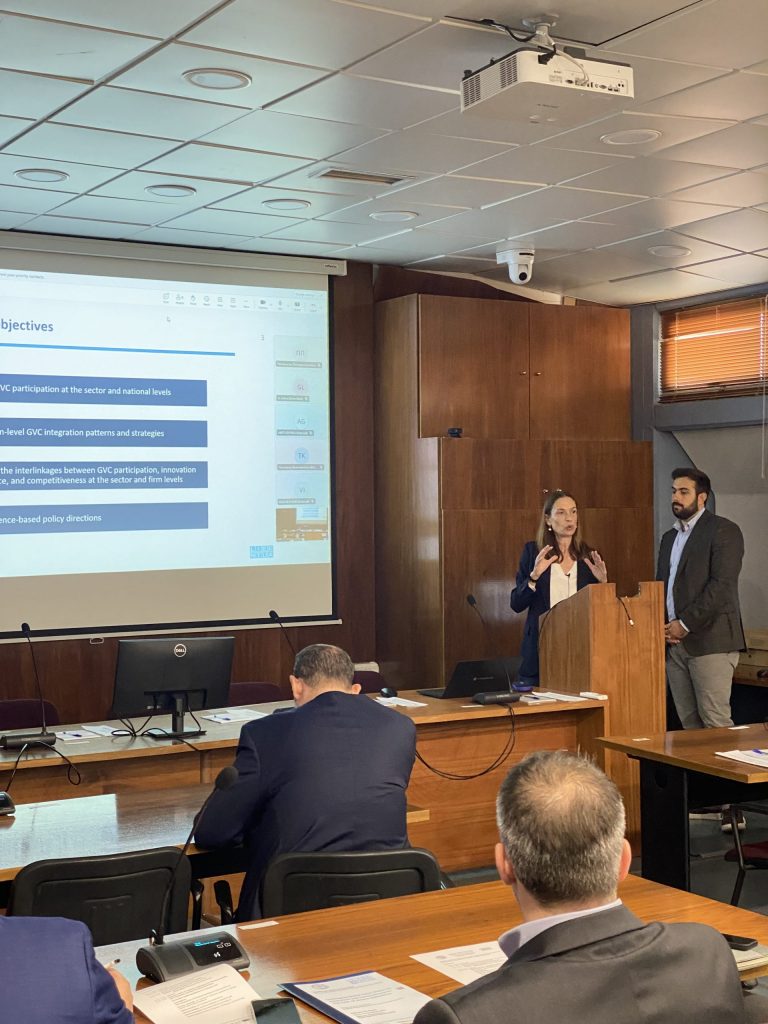
The project has four main objectives:
- To map Greece’s participation in GVCs, providing a rich set of participation indicators at the sector and country level.
- To study the participation incentives, integration strategy and expected benefits at the firm level, through a large-scale survey on selected sectors.
- To investigate the nexus of GVC participation, innovation performance and international competitiveness at the sector and firm level and unveil the underlying structural mechanisms that facilitate or hinder it.
- To provide evidence-driven policy recommendations and inform Greece’s relevant research, technology, and innovation (RTI) policy interventions.
The project will inform Greece’s Smart Specialization (S3) and future RTI strategies, focusing on three main pillars that these strategies aim to facilitate, namely globalization, growth, and competitiveness. The project treats these pillars as an interconnected triangle, where the main challenge is how to leverage globalization as a strategy for growth and competitiveness, through knowledge diffusion and innovation development in GVCs. In particular, the project aims to provide conceptual and empirical insights on the GVC-related dimensions of this triangle, which are rather underexplored for the Greek economy case.
The project’s objectives are expected to address the following challenges:
- Investigate and identify the benefits of participation in GVCs at the sector and firm level.
- Examine whether GVC participation holds innovation and growth potential for Greek firms and sectors.
- Understand how GVCs interact with the Greek national Innovation System (IS) and the ways GVC participation can enhance and upgrade the country’s innovation capabilities.
- Address Greece’s catching-up in terms of integration and competitiveness in global markets.
- Highlight the pervasive structural weaknesses that hinder the catch-up process and the potential comparative advantages that may facilitate it.
- Inform the country’s GVC participation strategy through a coherent and integrated set of policy and managerial recommendations.
- 14th Panhellenic Conference of Chemical Engineering
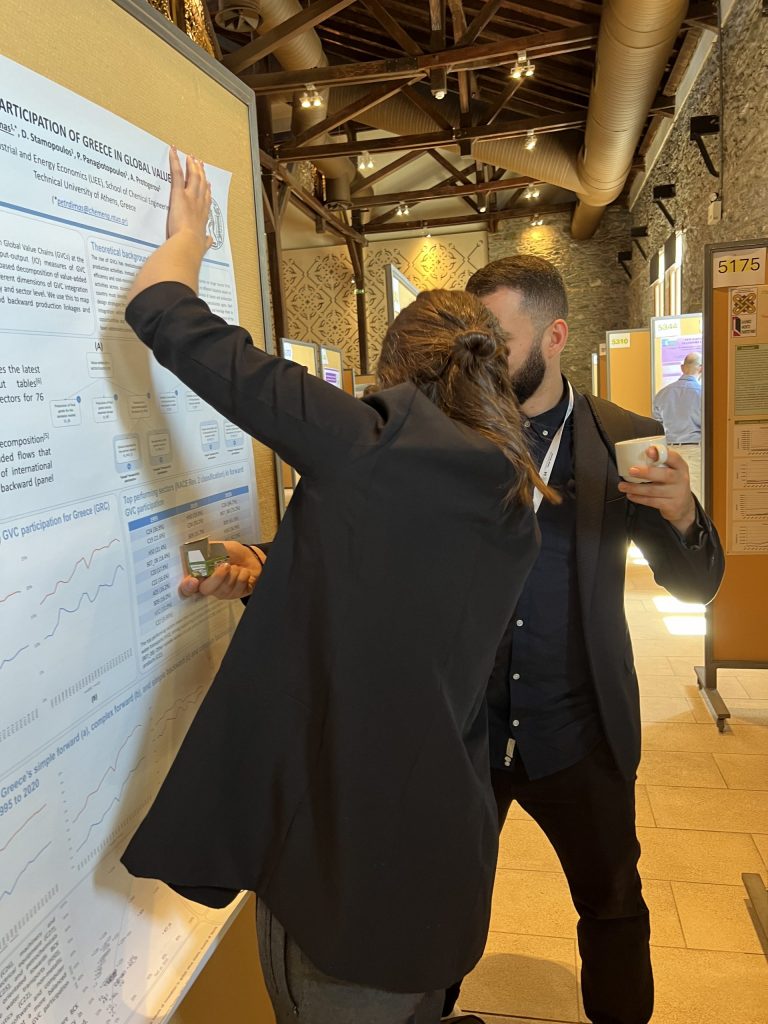
A full paper by Dimas, P., Stamopoulos, D., Panagiotopoulos, P., Protogerou, A. (2024), titled “Mapping the participation of Greece in global value chains” was presented in a poster form in the 14th Panhellenic Scientific Conference of Chemical Engineering, held on 29-31 May 2024 in Thessaloniki, with more than 500 participants. The paper featured results produced under WP2 of the project and was also included in the conference proceedings.
- 36th Annual EAEPE Conference
A working paper by Stamopoulos, D., Dimas, P., and Protogerou, A. (2024), titled “Participation and Positioning of Greek Sectors in Global Value Chains and Evolution of their Trade Patterns’’ was presented at the 36th Annual EAEPE Conference, held in Bilbao, Spain, on 4–6 September 2024, with approximately 350 participants. The objective of the paper was to map Greece’s forward and backward participation in Global Value Chains (GVCs) at both the country and sector levels.
The presentation was among the first contributions to the newly established research area Structural Economic Analysis (SEA) of the EAEPE Conference, and it attracted substantial feedback and comments. These inputs were instrumental in shaping the development of subsequent working papers and deliverables associated with WP3 of the project.
- Researchers’ Night 2025 and 2024
Over two consecutive years, the GRinGVCs research team showcased its work at LIEE’s kiosk during the Researchers’ Night events hosted at the NTUA premises, which attracted more than 2,000 attendees. In 2024, the team contributed the poster “Mapping the Participation of Greece in Global Value Chains” (Dimas, P., Stamopoulos, D., Panagiotopoulos, P., & Protogerou, A.). In 2025, the team expanded its outreach with a new poster, “The Role of Intangibles in Global Value Chains” (Dimas, P., Stamopoulos, D., Panagiotopoulos, P., & Protogerou, A., 2025). At both events, team members engaged actively with attendees, sharing the project’s objectives and discussing key research insights. The photo was taken by a drone and relates to the 2025 event.

- 20th Ermoupolis Seminar on the Information Society & the Knowledge Economy
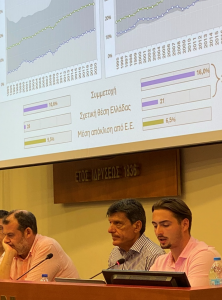
Kyriakis, G., Dimas, P., Protogerou A.: “Greece’s position in Global Value Chains and its productive linkages”, a contribution based on the dimploma thesis of G. Kyriakis conducted at LIEE/NTUA. The work examined the integration of Greek manufacturing in GVCs using the GRinGVCs database. The seminar, organized by LIEE on 10-13 July 2025 in Syros with 100 participants, hosted the presentation within the session “Productive Reconstruction and Sustainable Development”.

- 51st EBES Conference
Two research outputs from the project’s WP3 were accepted for presentation at the 51st International Conference of the Eurasia Business and Economics Society (EBES), held in Rome on April 11-13, 2025, with 200 participants:
- Dimas, P., Stamopoulos, D., Kontolaimou, A., Protogerou, A.: “Global Value Chains and Industrial Innovation in Europe”. This study, jointly utilizing the GRinGVCs and the ESPAT databases, empirically investigated the contribution of GVC participation to the development of technological innovation in the European industry.
- Dimas, P., Stamopoulos, D., Kontolaimou, A., Protogerou, A., Panagiotopoulos, P.: “What Drives Participation in Global Value Chains in the EU?”. This study, using the GRinGVCs database, examined the determinants of participation in global value chains (GVCs) for the EU-27 and the UK over the period 1995-2020.
- 37th Annual EAEPE Conference
Two research outputs from the project’s WP3—building on the GRinGVCs and ESPAT datasets developed earlier under WP2 and WP3, respectively—were presented at the 37th Annual EAEPE Conference which took place in Athens, Greece, on 24–26 September 2025 and brought together approximately 350 participants. These outputs focused on the determinants of GVC participation and its contribution to industrial innovation:
- Protogerou, A., Dimas, P., Kontolaimou, A., Stamopoulos, D. “Linking Global Value Chains to Industrial Innovation: Evidence from the EU“. The scope of this study was to empirically investigate the contribution of global value chain (GVC) participation to the development of technological innovation in European countries.
- Stamopoulos, D., Dimas, P., Kontolaimou, A., Panagiotopoulos, P., Protogerou, A. “A study on the determinants of participation in global value chains in the EU”. This study aimed to empirically examine the determinants of GVC participation at the country level for the 28 EU member states over the period 1995–2020, with a particular focus on technological and knowledge-related factors—specifically, intangible assets—that shape GVC engagement.


- Validation Workshop
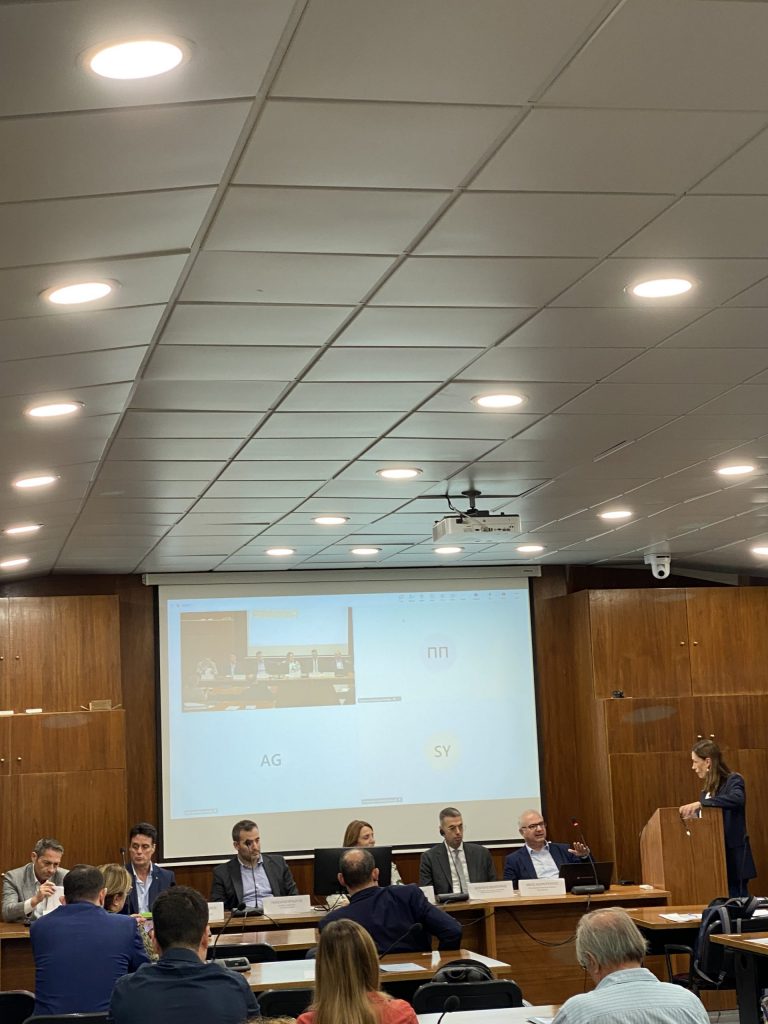
A central component of the project’s dissemination activities was the organization of a validation workshop on 11 November 2025. The workshop presented the project’s key findings, conclusions, and policy and business strategy recommendations to a diverse group of stakeholders, including academic experts, policymakers, and representatives of firms and business associations. The event also featured a roundtable discussion with executives from six major Greek manufacturing firms that had participated in the survey. The workshop aimed to evaluate the relevance, reliability, applicability, and overall usefulness of the research results, as well as the robustness of the proposed policy and managerial recommendations. The roundtable discussion, in particular, offered valuable insights into the practical implications of the findings, with industry practitioners highlighting emerging challenges and opportunities linked to Greek firms’ participation in global value chains, along with the key factors and mechanisms that facilitate upgrading within them.
For the validation workshop, the team produced an illustrated flyer summarizing the project’s main findings, which was distributed to workshop participants. Additional dissemination materials were also developed to present the project’s outcomes in a clear and engaging way, including poster displays with key infographics.