Validation Workshop of the research project: “Leveraging Global Value Chains for Innovation and Competitiveness: The Case of Greece (GRinGVCs)”

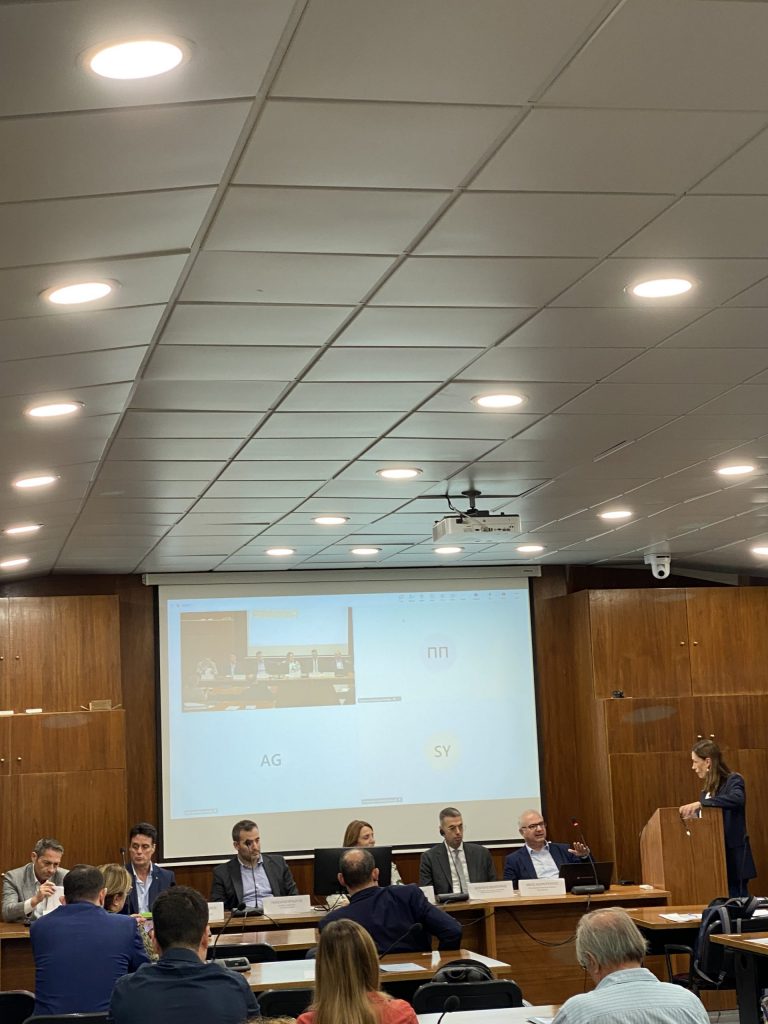
The Laboratory of Industrial and Energy Economics (LIEE) of the National Technical University of Athens (NTUA) organized the Validation Workshop of the research project: “Leveraging Global Value Chains for Innovation and Competitiveness: The Case of Greece (GRinGVCs)” (Principal Investigator: Aimilia Protogerou, NTUA Assistant Professor). The project was carried out within the framework of the National Recovery and Resilience Plan Greece 2.0, funded by the European Union – NextGenerationEU (Implementation body: Hellenic Foundation for Research and Innovation).
The workshop was held on Tuesday, November 11, 2025, from 16.00 to 19.00, in the “Koumoutsou” Hall of the School of Chemical Engineering at the NTUA Zografou Campus. Online participation was also available.
The Workshop’s Programme is available here.
The project’s main objective was to examine Greece’s participation in global value chains (GVCs), with a particular emphasis on the interplay among GVC integration and innovation performance as key drivers of growth and international competitiveness. The core premise is that globalization – manifested through integration into fragmented international production networks – can serve as a catalyst for innovation-led competitiveness, which, in turn, can serve as a backbone for the country’s structural and productive transformation.
The aim of the workshop was to present and discuss the key findings of the research project in order to assess the reliability, relevance, and usefulness of the research results, as well as the associated public policy and business strategy recommendations. The workshop brought together executives from businesses and business associations, policy experts, as well as researchers and academics with significant expertise in the project’s scientific field. Undergraduate and postgraduate students of NTUA also attended. The total number of participants in the validation workshop was 50.
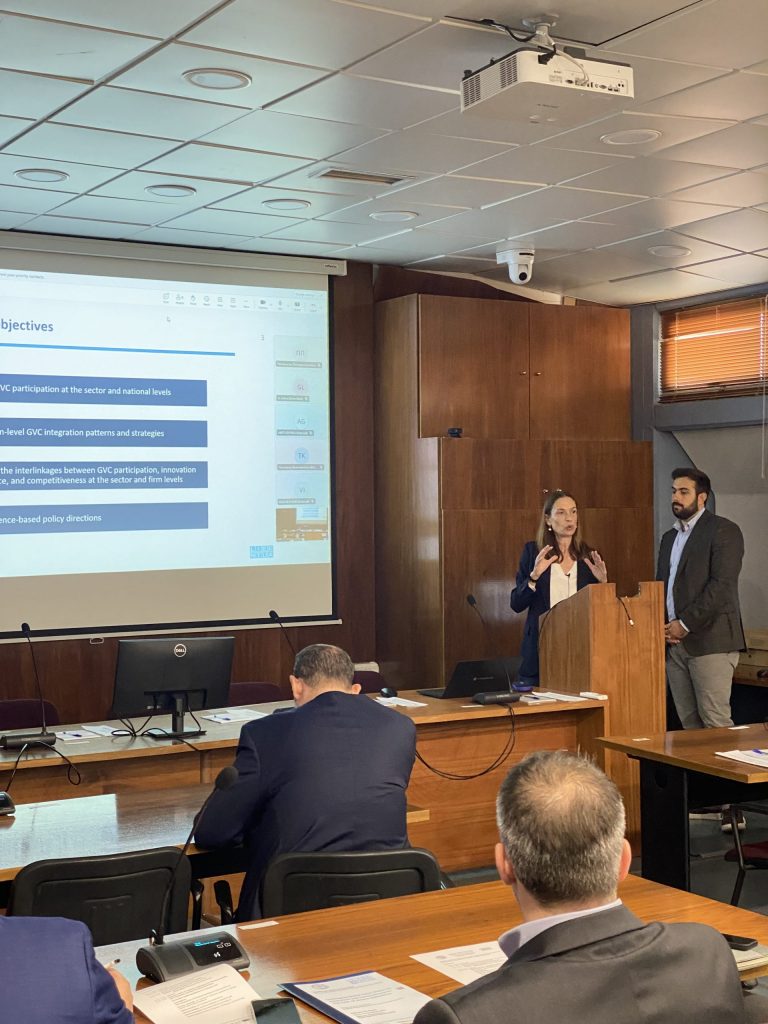
The workshop opened with a welcome address by Angelos Tsakanikas, NTUA Professor and Director of LIEE. This was followed by presentations by Aimilia Protogerou, NTUA Assistant Professor, and Petros Dimas, NTUA post-doctoral researcher, who presented the key findings of the research project and the corresponding public policy and managerial implications, formulated on the basis of the project’s two core empirical pillars.
The first pillar of the research work regards the country and sectoral level (macro level) and draws on two extensive databases developed within the project. These include a) the GRinGVCs database, which provides information on participation and positioning of 45 industrial sectors of 77 economies (including all EU27 members and other OECD countries) in global value chains, and b) the ESPAT database, which contains patent data (applications and grants) from the European Patent Office (EPO) for 99 industrial sectors of 24 European countries. The second pillar concerns the micro level analysis and is based on a field survey conducted with a structured questionnaire among 161 of the largest Greek manufacturing firms. The presentation of these findings was followed by a constructive discussion, with participants posing questions and providing comments that further enriched the analysis.
Subsequently, an organized discussion – panel was held with executives from manufacturing firms that participated in the survey. The panel included: Nikos Adamopoulos, New Business Development Director of GALENICA S.A., Dionysis Ventouris, EU Funding & Continuous Improvement Manager of SIDENOR STEEL INDUSTRY S.A., Violeta Ioannidou, CFO and Chair of the Board of Directors of ELASTOTET S.A., Manolis Bazigos, CEO of N. BAZIGOS S.A., Vasilis Boursinos, COO of MAILLIS METALS SOLUTIONS S.A., and Giannis Tserepas, CEO and Chair of the Board of Directors of LARIPLAST S.A. The discussion focused on targeted questions regarding the extent and nature of their firms’ participation in global value chains, as well as the strategic planning challenges and opportunities arising from this engagement.
The workshop provided a constructive platform for dialogue and the exchange of views, underscoring the relevance and practical value of the project’s findings for both business practice and current public policy in Greece. Insights gathered from the discussion directly informed the final formulation of the project’s main conclusions and policy recommendations. These contributions reinforced the central finding that Greece’s position in global value chains remains largely peripheral and must be strengthened through coordinated efforts aimed at enhancing value creation and supporting the country’s productive transformation.