
 Knowledge intensive entrepreneurship lies at the core of the structural shift necessary for the growth and development of a knowledge based economy, yet research reveals that the EU has fewer young leading innovators, and Europe’s new firms do not adequately contribute to industrial growth. This is especially true in the high R&D intensive, high-tech sectors. This structural malaise, undermining Europe’s growth potential, is well diagnosed, but poorly understood.
This volume fills this important gap by exploring new firms that have significant knowledge intensity in their activity and develop and exploit innovative opportunities in diverse sectors. Through an evolutionary and systemic approach to entrepreneurship, focusing on knowledge intensive entrepreneurship as both a micro and a macro phenomena and analyzing firms in the context of various socio-economic models, the authors explore firms creation and origins around the world, their organization, strategies and business models as well as the role of innovation systems and institutions in their formation and growth.
This comprehensive research text is vital reading for academics, researchers and students of high-tech and knowledge intensive entrepreneurship as well as those with an interest in industrial dynamics, innovation management and public policy.
Edited By Franco Malerba, Yannis Caloghirou, Maureen McKelvey, Slavo Radoševic
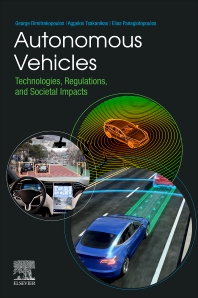 Autonomous Vehicles: Technologies, Regulations, and Societal Impacts explores both the autonomous driving concepts and the key hardware and software enablers, Artificial intelligence tools, needed infrastructure, communication protocols, and interaction with non-autonomous vehicles. It analyses the impacts of autonomous driving using a scenario-based approach to quantify the effects on the overall economy and affected sectors. The book assess from a qualitative and quantitative approach, the future of autonomous driving, and the main drivers, challenges, and barriers. The book investigates whether individuals are ready to use advanced automated driving vehicles technology, and to what extent we as a society are prepared to accept highly automated vehicles on the road. Building on the technologies, opportunities, strengths, threats, and weaknesses, Autonomous Vehicles: Technologies, Regulations, and Societal Impacts discusses the needed frameworks for automated vehicles to move inside and around cities. The book concludes with a discussion on what in applications comes next, outlining the future research needs.
G.Dimitrakopoulos, A.Tsakanikas, E.Panagiotopoulos,
“Autonomous Vehicles: Technologies, Regulations, and Societal Impacts”
https://www.elsevier.com/books/autonomous-vehicles/dimitrakopoulos/978-0-323-90137-6
Approved by the action KALLIPOS the writing by the research team of EBEO (2) of two electronic textbooks for undergraduate teaching. One will be on Project Management and the other on Technology – Innovation – Entrepreneurship.
Expected publication at the end of 2021.
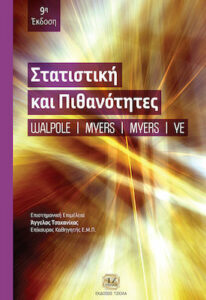
- Associate NTUA Professor Aggelos Tsakanikas edited the Greek version of the book by R.E. Walpole, R. H. Myers, S. L. Myers, K. Ye, “Probability & Statistics for Engineers & Scientists”, 9th Edition, Prentice Hall. 2019. It is utilized in the context of the core course of the School of Chemical Engineering, “Statistics and Experimental Design for Engineers”.
Summary
Contains: Introduction to Statistics and Data Analysis, Probability Theory, Random Variables & Probability Distributions, Introduction to Mathematical Statistics of Estimates, Discrete Probability Distributions, Continuous Probability Distributions, Two Random Functions & Samples, Basic Data Single-sample and two-sample hypotheses, Simple linear regression & Linear correlation, Multiple linear regression and nonlinear regression models, Single-factor experiments, Factor experiments, 2k-factor experiments in the class, Statistical Tables & Evidence, Answers to selected problems.
Publisher: Tziola
Format: Hard cover
Year of publication: 2019
Number of pages: 744 - ISBN-10: 9604187171
- ISBN-13: 9789604187171
- Dimensions: 29×21
 Abstract:
The book deals with various aspects of the issue of the Information Society and the Knowledge Economy, and largely combines theory with empirical data and examples from Greece, Europe and elsewhere. It begins by placing Information and Communication Technologies (ICTs) in a historical context, analysing the reasons why they are a General Purpose Technology and have led to the emergence of the most recent major techno-economic paradigm and the triggering of an ongoing socio-economic transformation. Chapter 2 seeks to contribute to a deeper understanding of the processes, the forces driving them, the obstacles and the structural problems associated with the effort to develop the Information Society in Greece. The object of Chapter 3 is to describe the evolutionary path of mass computing information and communication technologies, as well as current technological trends and forecasts (Cloud Computing, Internet of Things, etc.). Chapter 4 deals with the topic of open technologies in the ICT field, namely Free Software/Open Source Software (FOSS), Open Standards and Open Hardware. Chapter 5 analyses the concept of eGovernment, describing how it is defined and its main benefits, the methodology for measuring its level of development and the basic conditions for its realisation. Chapter 6 deals with the concept of the ICT Ecosystem and emphasizes the Greek case, analyzing the characteristics of companies operating in the field, in comparison with the international environment, in order to highlight the Greek specificities. Chapter 7 is devoted to the analysis of the degree of utilization of ICT by the domestic production system, and includes several empirical data and examples. Chapters 8 and 9 deal with the issue of telecommunications and broadband, and in particular describe the role of the public sector in the development of new generation broadband networks (fibre optics) and the main methods available for calculating the cost of telecommunications/broadband services respectively. Chapter 10 analyses the changes that ICT, and in particular the Internet, have already brought and are expected to bring about at individual and societal level, such as the possibilities they offer in the fields of work, education and health (teleworking, eLearning, eHealth). The final chapter of the book makes a more specific reference to the role of information technology and the Internet in education and research, and attempts to review IT applications in the field of engineering and research.
Authors:
Kalogirou, Giannis
Panagiotopoulos, Panagiotis
Tsakanikas, Angelos
Siokas, Evangelos
Karounos, Theodoros
Magklaris, Vasileios
Troulos, Kostas
Kalogeras, Dimitris
Tsiavos, Prodromos
Kanellos, Nikos
Merekoulias, Vasilis
Creation Date: 13-05-2016
Publication Origin: Kallipos, Open Academic Editions
68Number of pages: 375
Language: Greek
Κωδικός ISBN:978-960-603-381-0