
NTUA Professor Mr. Giannis Kalogirou attended the InSySPo International Conference to be held on June 6-7, 2018 at the University of Campinas, Brazil. The theme of the conference was: “Innovation Ecosystems, Technology Upgrading and Regional Development”. Mr. Giannis Kalogirou addressed the issues of Social Inclusion, Regional Employment Dynamics, Culture, Local Knowledge.
The text of NTUA Professor G. Kalogirou’s presentation can be found here (pdf file).
The conference provided information on these complex questions, examining a range of topics and focusing on evidence and lessons for emerging economies. Among other things, the possibility of knowledge entrepreneurship to include both small business firms and corporate entrepreneurship in established operators, which are of great importance for emerging economies, was examined. More specifically, the main thematic sections were:
1. Business demography: birth/entry, survival, death/exit, growth. Geography
of knowledge-intensive businesses.
Factors contributing to the dispersion of demographic business activities across regions/countries: quality of local governance, research and development spending, workforce education, business-friendly regulations, financing constraints. Emphasis on knowledge-intensive businesses.
2. Barriers to innovation for small businesses. Spatial specificities.
The literature has identified a long list of potential economic and non-economic barriers to innovation, such as excessive risk, high innovation costs, lack of financing, organizational rigidity, lack of skilled personnel, lack of IT, insufficient market information, , standards and lack of technical services. These barriers affect the impact on innovation of firm-specific factors (size, R&D expenditure, knowledge acquisition and adaptation), network-related factors (external sources of financing and information, public procurement, tax breaks and subsidies).
3. Regional innovation ecosystem, smart specialization, global value chains (GVC)
Scholars have highlighted the importance of interactions between elements of a business system. Undoubtedly, entrepreneurship needs to be studied at the regional level and in close proximity to regional innovation systems, with an emphasis on networks, learning, interactions, as well as the strong links of local actors and international actors, such as multinational corporations. The rapid expansion of global value chains in recent decades introduces a particularly important element to be examined. Significant areas of ambiguity remain, however, such as understanding the institutional framework of interactions, including the role of universities and public research institutions. Smart specialisation has emerged as a location-based approach to analysing the strengths and potential of an economy and identifying strategic areas for policy intervention.
4. Social inclusion. Regional employment dynamics, culture, local knowledge
The concept of Responsible Research and Innovation (RRI) has been promoted to indicate a broader inclusion in research and innovation activities. Social actors – researchers, citizens, policy makers, businesses, third sector organisations, others – are supposed to work together to ensure a better alignment of R&I outcomes with the values, needs and expectations of society. Regions often demonstrate their own dynamics, culture, historical background and educational achievements, which could play a useful role in informing public policy on research, innovation and socio-economic development.
For more information about the conference, visit the official website by clicking here.
The official conference programme can be found here (pdf file).
The Symposium entitled: After High School What? For the Radical Restructuring of the Post-High School Education, Training and Research Area, organized by PRO.PADEI.A on the weekend of 8-9 June 2018. Among the speakers, Mr. Angelos Tsakanikas, Assistant Professor of NTUA and member of the LIEE and Mr. George Siokas, PhD Candidate of NTUA and member of the LIEE. He is a lecturer and a member of the Greek Academy of Sciences, Mr. Giorgios Siochia, who is a PhD candidate and a member of the Greek Academy of Sciences, Mr. Giorgios Siochia. Professor commented on the need to link research with production on the basis of a new model of development and the PhD candidate on the initiatives that exist at NTUA and more specifically at the School of Chemical Engineering.
The press release as well as audiovisual material from the activities of the Symposium can be found here.
The main purpose of the Symposium was, on the one hand, to discuss the pathologies and causes that have shaped the Postsecondary Education and Training sector in the last decades and, on the other hand, to highlight proposals and perspectives for a new serious and credible structure that is necessary to be created in the Postsecondary Education and Training sector, with a focus on:
The rational reorganization, evaluation and accreditation of the Higher Education and Research area, and the reform in the Vocational Training area. The common thread of the excellent speeches during the Symposium was the realization that in the effort to radically restructure the post-secondary education sector, it is necessary to simultaneously develop General Education and Training, which will give the required respect to the multifaceted development of the personality of each citizen, taking into account the messages and trends from the labour market and real conditions with an eye to the future. In total, during the Symposium, topics from five different sections were analysed. More specifically:
1st Thematic section The new serious and credible structure that should be created in the Post-secondary non-university Education and Training Area.
N. Moussiopoulos, Professor of the Faculty of Engineering, Aristotle University of Thessaloniki, presented nine prerequisites for a successful Vocational Education and Training (VET) system, including the need for the symbiosis and emergence of distinct and equal systems of Academic Education and VET. N. Paizis from KANEP/GSEE referred to the consequences that will arise in Lyceum and Higher Education from the formation of Post-secondary Education, while T. Mihou from SEV spoke about the need to redesign and upgrade initial vocational education and training with the active participation of enterprises. The presentation of Ath. The presentation of A. Syrianos, Vice President of the Hellenic-German Chamber of Commerce and Industry on the initiative of the Greek Brewery of Atalante for the vocational training of brewers, and the presentation of Aik. Kouli, former Managing Director of the Centre for Innovation and Productivity of the German Economy on the importance of Vocational Education in the national education system.
2nd Thematic Unit: Towards a modern and rational reorganization of the single space of Higher Education and Research in accordance with the international reality and contemporary trends.
Among the issues discussed in the 2nd session, the position of An. Karampatzos, An. Professor of the University of Cyprus, on the reorganization of the legislative framework with reference to the need for an extroverted-open Higher Education, the Rector of the Open University of Cyprus, Prof. S. Katsikas, on the similarities and differences between the mergers of Universities in Europe and Greece, and K. Axarloglou, Dean of International Business and Strategy of ALBA Graduate Business School, on the importance of establishing evaluation systems and motivation models for research and teaching staff of the Universities. At the same time, the student of EKPA, Or. Angelopoulos presented academic life and the path to excellence from the students’ point of view, describing the example of the Law School.
3rd Thematic Unit: Reforms in Vocational Education & Training: challenges and necessary changes
At the beginning of the 3rd thematic unit, S. Zarkos, An. Professor at ALBA, spoke about the important role of Business Schools in the professional education and training of business executives, while M. Pavlakis, Consultant for Education and Development of Human Resources, spoke about the role, qualifications and competencies required of the modern Vocational Training Instructor. N. Gavalakis, Head of Human Capital Development Unit of SEV, also referred to the issue of skills production and demand in Greece, as well as M. Katharakis, Director of the Technical Schools of the Heraklion Chamber, who focused on the need to introduce innovations in the field of Vocational Education and Training. At the end of the discussion, K. Kaltsas, School Counsellor of Vocational Education commented on the need for the development of a VET system that will effectively serve the productive model of the country.
4th Thematic Unit: The periodic assessment and accreditation of all forms of formal education and training and research by a single authority – the HQA.
The speech of S. Koumbias, Prof. S. Koumbias, Professor. S. C. Kumbia, Professor, Faculty of Engineering, University of Patras, started the thematic module with a discussion on the evaluation of Greek Universities, the difficulties of implementation, but also the prospects that open up. Then followed the speech of Ioan. Gerothanasis, Prof. The speech of N. Hourvouliadis, Head of the Business School of the American College of Thessaloniki on the accreditation of Greek Private Colleges by Academic Institutions and Institutions from abroad followed. At the end of the thematic section, opinions from the students’ side were presented, and in particular, the example of the evaluation of Democritus University through the speech of the student of the Law School, V. Tatsis and the bottom-up initiative of the NTUA students, through the speech of G. Sioka, Lt. D. of the Faculty of Chemical Engineering.
5th Thematic Unit: The institutionalisation of the connection between the Educational and Research Area and the business, market, cultural, economic and social spheres.
At the beginning of his speech, Mr. Ap. Dimitropoulos, Scientific Associate of IOBE, referred to the need to reconnect Higher Education and the Labour Market, a topic which was continued by H. Dimitropoulos. Pappa from the Employment and Labour Market Sector of SEV, who focused on the need to strengthen the employability of young people. D. Polyzos, Deputy Chairman of the Board of Directors of the European Employment Agency, Mr. D. Polyzos, who spoke on the subject of employment, said that the employment of young people in the labour market was a key factor in the development of the employment market. D., Deputy Rector of Research and Development of the University of Patras, presented the Patras IQ platform for the interconnection of research and productive institutions, and A. Tsakanikas, Assistant Rector of the University of Patras, presented the platform for the interconnection of research and productive institutions. Professor of NTUA commented on the need to link research and production on the basis of a new development model. Areti Krepapa, Dean of Graduate and Professional Education at Deree, spoke about the role of Learning through Community Service, linking Higher Education with Society and K. Rotsios, Dean of Undergraduate Programs at Perrotis College of the American Farm School in Thessaloniki focused on the value of Postgraduate Education for the future of the Agri-food sector in Greece. The thematic session was closed by Ch. Apostolopoulos, President of SEVGAP, who highlighted the need to create bridges between businesses and educational and research institutions.
This year’s Ermoupolis Seminar on the Information Society & the Knowledge Economy, organized annually by the INFOSTRAG Team of the Industrial and Energy Economics Laboratory of NTUA, will be held from July 12-15 (Thursday afternoon – Sunday morning) at the Conference Hall of the Cyclades Chamber.
The team is now in the process of formulating the program, which is characterized by four main axes: 1) Innovative Entrepreneurship, 2) Infrastructure/Networks + Energy Issues, 3) Education, 4) Local Development.
Petrochem Day – Completion of the first day on the Petroleum Cycle from Chemecon, Friday 04/05/2018
Petrochem Day 2018, the first conference with the central theme of the oil cycle in Greece by Chemecon, was successfully concluded. The conference was held at the Michael Cacoyannis Foundation and had more than 200 participants. Attendees had the opportunity to attend keynote speeches on various oil and gas topics, to get in touch with people from the companies participating in the event and to participate in discussions with invited researchers in the Research Corner.

Presentation of Chemecon by its president George Siokas
The conference was attended by large companies, specifically DEPA/DESFA, Motor Oil, Coral, Energean Oil & Gas, Management Force, Ergonomia, ENOIA, ELDON’S.
In the research corner, which was held during the first two breaks, the researchers who participated were Ms. Irini Petropoulou and Mr. Andreas Giotis.
EPI.noo, the research and entrepreneurship interface structure of NTUA, was also present for general information and discussion regarding the possibilities of research, innovation and entrepreneurship.

Representatives of In*vent ICT and EPI.noo (Dr. Nikolaos Kannelos and Dr. Evangelos Siokas) in the research corner
The day was closed by the professor of the School of Chemical Engineering of NTUA, Mr. Ioannis Kalogirou, who spoke briefly about Chemecon’s actions in recent years, as well as about the active participation of students in similar initiatives.
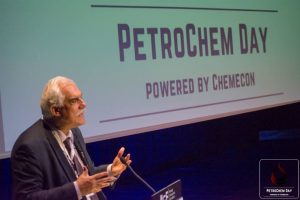
NTUA Professor Ioannis Kalogirou closing the conference
Participation in the Student Conference of Administrative Science and Technology 2018, which was held in May 2018 in Athens at the headquarters of EEDE. The LIEE participated with one paper:
Siokas, G., Stamelos, P. and Dimas, P.: Search for the Determinants for the Business Development of “Smart Cities”. Abstract