
 Abstract:
The present book, a collaborative effort between academics and engineers with many years of professional experience, addresses the approach and practice of Project Management. It focuses on a fundamental professional activity for engineers and other scientists as more and more organizations and enterprises operate based on projects that support their typical organizational structures. The starting point and focus of the book is the management of engineering projects in industry, covering the definitions, principles, concepts, and phases of project management, as well as the analysis of individual stages and operations. Specifically, it discusses project planning, scheduling techniques, the organization and management of necessary engineering studies, technology selection, procurement, and various procurement contract forms, the organization of construction, testing, and commissioning of a new production unit, monitoring and controlling the implementation process and taking corrective actions, risk management, coordination and communication processes, and human resources management. The book also includes a series of case studies based on the authors’ experience, characterized by diversity in relevant fields (natural gas plant, municipal wastewater treatment plant, company relocation project, IT project). These case studies aim to provide a deep understanding of the horizontal application of basic project management principles while highlighting the relative differences between different project types in methodology, critical factors, and stages. Each chapter begins with a description of its learning objectives and ends with comprehension questions.
Authors:
Caloghirou, Yannis
Diakoulaki, Danae
Protogerou, Aimilia
Franses, Symeon
Gekas, Achilleas
Kalantzis, Polyvios
Panagiotopoulos, Panagiotis
Creation Date: 19-03-2025
Publication Origin: Kallipos, Open Academic Editions
68Number of pages: 368
Language: Greek
Κωδικός ISBN: 978-618-228-310-3
Technology – Innovation – Entrepreneurship
 The present book explores the relationship between knowledge, innovation, and entrepreneurship, with a particular focus on the characteristics and development of innovative entrepreneurship within an economic context such as the Greek one. The starting point is the empirical evidence of the strategic significance of technology and innovation for both businesses and society, which is supplemented by the requisite theoretical constructs for a comprehensive understanding of the multifaceted process of innovation management for established or new firms. In this vein, the fundamental types of entrepreneurship are discussed, with an emphasis on innovative knowledge-intensive entrepreneurship. This refers to enterprises, irrespective of industry, that leverage knowledge and technology to engage in innovative activities, thereby making a substantial contribution to economic growth and societal welfare. The book also covers issues such as value creation from innovation, the protection of intellectual property rights, the investigation of financing sources and tools, and the pursuit of competitive advantage through the evaluation of technical, financial, and operational data. In addition, the book offers a practical guide for business plan development, with a focus on its key contents and information that must be included and presented in a comprehensive manner. It thoroughly presents the entire cycle of business development, from the evaluation of opportunities, the conception of the business idea, the assessment of its feasibility, the exploration of the appropriate financing scheme, as well as the formation and composition of the business team, to the initial phase of the investment plan implementation. In the same context, the book presents and elucidates the key features of the Business Model Canvas methodology, which is one of the current go-to methods for mentoring and guiding the development of a new knowledge-intensive venture. Finally, the manuscript presents case studies of innovative, knowledge-intensive business ventures from both Greece and abroad.
Authors:
Tsakanikas, Aggelos
Protogerou, Aimilia
Kastelli, Ioanna
Siokas, Evangelos
Panagiotopoulos, Panagiotis
Siokas, George
Dimas, Petros
Stamopoulos, Dimitrios
Creation Date: 02-05-2025
Publication Origin: Kallipos, Open Academic Editions
Number of pages: 314
Language: Greek
Κωδικός ISBN: 978-618-228-324-0
Associate Professor of NTUA Aggelos Tsakanikas and postdoctoral researcher of the LIEE-NTUA Petros Dimas sign the 2nd policy brief of the European Economy of theObservatory of the Greek and European Economy of theHellenic Foundation for European and Foreign Policy (ELIAMEP) entitled: “Taking advantage of the new EU industrial policy in the reshaping of Greece’s production model”.
The purpose of the policy brief is to expand and evaluate recent developments in industrial policy in the European Union, with the aim of highlighting the way in which they can function beneficially in the country’s productive transformation. In this context, some key points of the rather fragmented landscape of policies and strategies related to Greek industry are also presented and analyzed, and some future directions are mapped out that are deemed necessary so that the country can exploit the momentum of European industrial policy to its advantage.
The relevant publication of the text is available εδώ.here.
The text is available in Greek εδώhere (for the English version clickεδώ here)
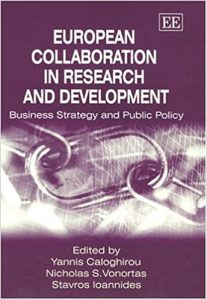 The last twenty years have witnessed a tremendous increase in industrial collaboration in research and development (R&D) both in Europe and the world at large. Firms have increasingly opted for collaboration in an effort to deal with the uncertainties that stem from rising research costs, rapid technological change and the development of a network economy. Governments have been quick to support this trend in order to promote competitiveness and, in the European context, to foster cohesion.
The contributions collected in this volume focus explicitly on cooperative R&D in Europe. The first part of the book offers empirical evidence on the extent, scope and direction of this collaboration and explores the motives and problems of the participating firms, as well as the perceived benefits they have enjoyed. The second part deals with the difficult policy issues that diverse national R&D regimes create for successful cooperative research and international convergence. The extensive survey results of European firms allow the authors to compare collaborative research policies in various EU countries and contrast the policy design that has emerged in the EU with that of the USA.
This book offers the most comprehensive account of collaborative industrial research in Europe and explores both the business strategies that have motivated it and the public policies that have promoted it. Academics, graduate students, government agencies and European institutions involved in science and technology policy and R&D management will find this volume to be invaluable. It will also be of great practical use to companies interested in forming strategic technical alliances.
by Yannis Caloghirou (Editor), Nicholas S. Vonortas (Editor), Stavros Ioannides (Editor)
Knowledge Flows in European Industry
 The channels and mechanisms of knowledge flows define the links that make up production and innovation systems. As such, they relate directly or indirectly to all policies that affect such systems. Knowledge flows are also directly related to intellectual property protection policies and competition policies that create the infrastructure supporting various forms of formal interaction among economic agents in production and innovation systems.
Knowledge Flows in European Industry presents the results of an extensive research programme funded by the European Commission to empirically appraise the dissemination of knowledge relevant to the innovative activities of European manufacturing and service sectors. It explores the extent, density, and mechanism of innovation-related knowledge flows affecting the innovative capacity of European industry and the mechanisms that support such flows, as well as examining incentives to access and transmit results and the determinants of knowledge transmission.
Featuring contributions from leading international scholars including Anthony Arundel and Bent Dalum, this interdisciplinary volume focuses on questions of interest to regional, national, and pan-European science, technology and innovation policy, and will be an important read for those involved in business and management as well as those in the field of economics.
Edited By Yannis Caloghirou, Anastasia Constantelou, Nicholas Vonortas